9th September, 2026
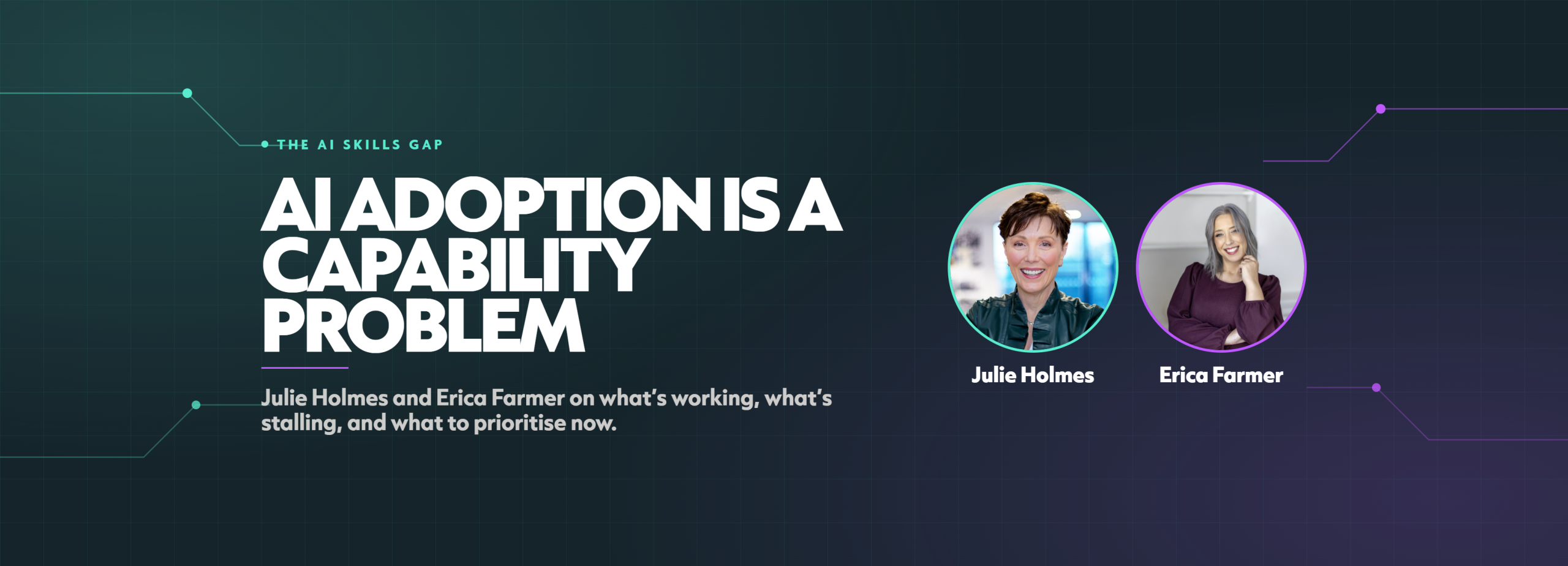
On 9th September, we hosted a webinar on AI adoption with Julie Holmes and Erica Farmer, hosted by Raise the Bar Founding Director Steve Smith. The conversation kept circling back to one thing: the AI skills gap, and why it’s proving harder to close than most leadership teams expected.
Here’s what came out of the conversation, and what we heard back from the room.
The AI skills gap isn’t a technology problem
The session opened with the premise most leaders already suspect but don’t always say out loud: the strategy gets signed off, the tools get bought, and the investment still sits unused. Julie Holmes, AI strategist and tech founder, put it plainly when the conversation turned to what “AI rollout” actually looks like in practice. It isn’t just companies handing out licenses. She pointed to Malta as an example of what a genuinely ambitious rollout looks like, an entire country given ChatGPT access alongside a national AI literacy programme. The comparison landed because it reframed the question most businesses are quietly asking. It’s not “have we bought the tools”, it’s “have we built the capability to use them.”
AI fatigue is real, and it has a name now
One line from the chat summed up a feeling a lot of people in the audience clearly recognised. A comment described the exhaustion of trying to keep up with AI as being “exciting but mentally tiring.” Julie’s response gave it a name: being AI-enthusiastically-exhausted. Erica Farmer, who works with organisations on the human side of AI adoption, agreed it was a feeling she sees constantly in the businesses she works with.
“Exciting but mentally tiring.”
How one attendee described keeping up with AI
It’s a small moment, but it mattered. A room full of HR, L&D and transformation leaders recognising their own exhaustion in a throwaway line says something the survey data doesn’t always capture: the emotional cost of adoption is as real as the AI skills gap itself.
Reluctance isn’t the same as resistance
A recurring theme in the questions was what to do about people who are against using AI, or simply not ready to adapt. Julie’s answer was to treat reluctance as a diagnostic problem before it’s a training problem. Find out why someone is reluctant first. Is it that they don’t understand the tools? Do they have a genuine moral objection? The starting point isn’t a mandate, it’s leaders visibly demonstrating good AI practice and clear principles that explain why AI fits into how the organisation works, not just that it does.
This came up again from someone working in the public sector, who raised a genuine tension many leaders are navigating. High-profile data breaches and security concerns create a risk-averse culture, and that caution can end up blocking opportunities that are sitting in plain sight. Erica’s response drew a distinction worth repeating: a policy outlines risk, but organisations also need what she called a manifesto for how they innovate. Both have to exist side by side. Risk management without an innovation stance just produces paralysis. Left unaddressed, that hesitation is exactly what keeps the AI skills gap open long after the training’s been rolled out.
Data safety was the practical question people actually wanted answered
Beyond the bigger strategic questions, there was real appetite for the basics. Where do you even start with training? Prompting? Which of the hundreds of YouTube tutorials are worth trusting? And underneath all of it, a very specific fear: how do you use AI tools without accidentally putting sensitive data somewhere it shouldn’t be, particularly for organisations operating under UK and EU data rules.
Julie’s guidance was direct. Understanding licenses and data safety has never mattered more. As a rule of thumb, no confidential or proprietary data should go into personal AI tools, even ones you’ve paid for. There are safe, enterprise-grade options built for exactly this, and knowing the difference is the first practical step.
The questions we didn’t get to
Even with the extra time, we couldn’t get through everything. Two questions in particular stuck out for the level of thinking behind them. One asked about the environmental impact of AI, and what businesses and individuals can realistically do about it. Another asked whether companies are moving too fast on adoption without fully working through the ethical implications of how they’re using it. Erica’s answer to that one is worth sitting with: we don’t yet know all the impacts, so organisations need to be agile and flexible enough to hold two things as true at once, moving forward and staying alert to what we still don’t know. That kind of unresolved thinking is part of the AI skills gap too, not just the tools people haven’t learned, but the judgement calls nobody’s fully worked out yet.
If you had a question that didn’t get answered live, our team is happy to follow up. Send it to enquiries@raisethebar.co.uk.
What we learned from this AI Adoption Webinar
None of this points to a single fix. What it does point to is a mismatch that Julie and Erica have been describing all along, between how much technology organisations have deployed and how much capability they’ve actually built around it. The businesses making progress aren’t the ones with the most sophisticated tools. They’re the ones treating the AI skills gap as a people problem first and a technology problem second.
That mismatch shows up in the wider research too. McKinsey’s State of AI work has tracked the same pattern across thousands of organisations: most now use AI somewhere in the business, but far fewer have redesigned how their people actually work as a result. Closing the AI skills gap is where most of the real work still needs to happen.
Meet the speakers
AI expert, inventor and tech founder who helps leaders use AI to stand out, not just keep up. |
One of the UK’s leading voices in AI, with 25 years of experience across Learning and Development. |